
By Bookum Team, Sep 17, 2026
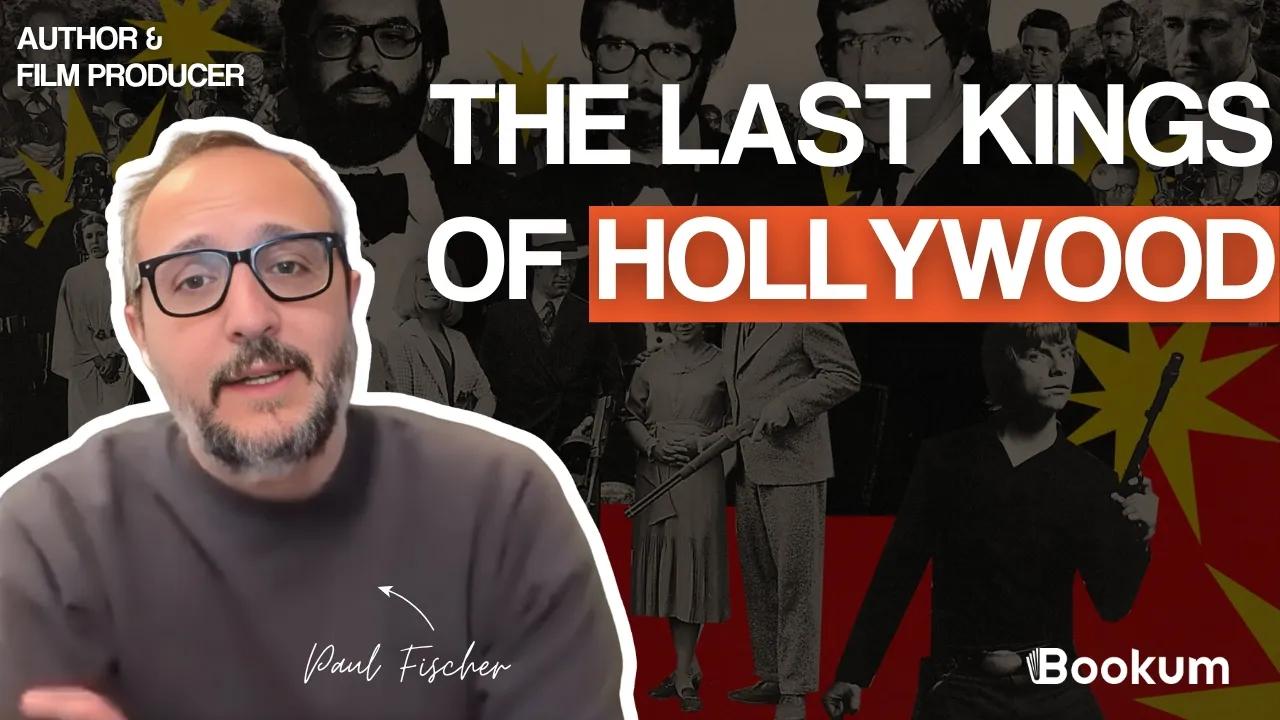
Our Author Talks Podcast with Paul Fischer, Author of The Last Kings of Hollywood: Coppola, Lucas, Spielberg and the Battle for the Soul of American Cinema
There are movies that become hits.
Then there are movies that change the entire movie business. Before, we had the “Summer Blockbuster” season, we had the 1975 that started it all… ‘Jaws’.
We sat down with Paul Fischer, a film producer, writer, filmmaker, and author of NY Times Bestselling Book The Last Kings of Hollywood, to talk about Francis Ford Coppola, George Lucas, and Steven Spielberg before they became the names we know today.
What stood out was most were their fanaticism with filmmaking at a young age.
Before The Godfather, Jaws, and Star Wars, these were young filmmakers trying to figure out how to get into an industry that did not really want them.
They were ambitious outsiders and they were sometimes broke because of it.
But they also understood something important.
The Hollywood system was changing.
And they figured out how to be the change makers.
Listen to our full conversation with Paul Fischer:
Below are the most important moments from our conversation, edited for clarity and flow.
Before Coppola, Lucas, and Spielberg Became Hollywood Icons
Kyle: What made Coppola, Lucas, and Spielberg unique?
Paul Fischer:
“They were basically best friends, really young best friends.”
“Imagine if you make the biggest film ever like Coppola did with The Godfather, and then your best friend makes the next biggest film ever like Spielberg did with Jaws, and then your other best friend makes Star Wars.”
They were young filmmakers in their twenties who believed they could change Hollywood and they had completely different personalities.
Fischer describes Coppola as someone willing to take enormous risks.
Lucas was more calculated (hence he made the least amount of films compared to Coppola and Spielberg).
While Spielberg was more comfortable working inside the system.
Hollywood Was In Trouble
Kyle: What was Hollywood like before these filmmakers came along?
Paul Fischer:
“The traditional film industry was kind of dead.”
The old studio system had been built around centralized control.
Studios controlled filmmakers. Actors were under contract. Careers followed a specific path.
Then the system started breaking apart.
Studios lost control of theaters. Filmmakers gained more freedom (same as we are seeing now with filmmakers and creators with their own platforms and distribution). Television was changing what people wanted to watch. Young people were watching foreign films, television, and reading comic books.
Hollywood had a problem.
It needed to figure out what younger audiences wanted.
And suddenly these young film school graduates looked a lot more interesting.
Fischer explains that the studios were looking around and asking a simple question.
“Who is going to understand the kids? Who is going to make films for the kids?”
Coppola, Lucas, and Spielberg were the answer.
American Zoetrope and the Fight for Creative Freedom
Coppola and Lucas eventually moved to San Francisco, not Hollywood, and founded American Zoetrope.
The idea was simple.
They wanted to make films without having to answer to the traditional Hollywood system.
But there was a problem.
You still need money to make movies.
Paul Fischer:
“Especially at that time, film making is a commercial venture.”
“They wanted to make personal films, but you have to get the money to make them and make enough money to keep making them.”
That tension runs through the entire story.
How do you make the movie you want to make (the personal film) while still making enough money to keep making movies?
That is the question filmmakers are still dealing with today.
Francis Ford Coppola Taught George Lucas the Power of Writing
One of the most interesting relationships in the book is between Coppola and Lucas.
Paul Fischer:
“Lucas hated writing. He was not a writer.”
But Coppola understood something that changed Lucas career.
“If you do not write, then you are dependent on what other people have written that you are being offered.”
“And if the stuff is good, you have to hope they choose you. You have to beg to be the director. You have to fight for it.”
“But if you write your own stuff and your own stuff is good, then no one can tell you what to do because you have started the whole process and you control the whole process.”
That idea would become extremely important to George Lucas as he struggled through draft after draft of American Graffiti and later Star Wars.
The Godfather Changed Coppola’s Career
Coppola originally did not see The Godfather as the perfect opportunity.
He needed the money.
He thought the gangster movie was beneath him.
But then he figured out something important.
Paul Fischer:
“Maybe the way to do this is not always to start with a personal subject and try and make it commercial.”
“Maybe you take a commercial subject and find a way to make that personal.”
That became the strategy.
Coppola took a bestselling gangster story (The Godfather by Mario Puzo) and found the parts that connected to him.
Family.
Brothers.
Rivalries.
Power.
Loyalty.
Betrayal.
He fought for Al Pacino when others did not see what he saw.
He fought for Marlon Brando.
He made a commercial film feel personal.
And it worked.
The Godfather became highest gross movie of all time in 1972, the year of its release.
Suddenly, the system had to take Coppola seriously.
Jaws Created the Modern Summer Blockbuster
Then came Spielberg.
Fischer explains that Spielberg was still trying to figure himself out when Jaws came across his desk.
He saw something different in it.
Paul Fischer:
“If I strip it down to what I love about movies, which is the kind of fear and thrill and wonder of something bigger and more dangerous in everyday life, and then I put an everyday guy in that because I want to identify with the everyday guy, then maybe I have something special.”
The production itself was a disaster.
The film was supposed to be much easier to make.
Then the crew went into the ocean. Filming in Martha’s Vineyard.
Machinery broke, the sharks did not work and the weather was chaotic. The shooting was suppose to take less than 60 days but Fischer told us the production eventually went roughly 140 days over schedule.
People questioned Spielberg, who was at that time consider young protege and some wanted him replaced as director.
Then the movie came out and Spielberg passed Coppola’s 1972 “The Godfather” to become the Top Grossing Movie of All-Time Worldwide in 1975.
Because it took so long to shoot, the studio decided to release in theaters all over the national, instead of the normal city by city approach. Jaws mania took over.
And the modern summer blockbuster was born.
George Lucas Was Playing a Different Game
While Coppola was taking big swings and Spielberg was learning how to work within Hollywood, Lucas was building something else.
Control.
Star Wars was not just another movie for Lucas.
It was a way to create his own ecosystem.
Paul Fischer:
“If I can control as much of this as possible, then maybe I can turn it into something.”
The Star Wars Deal That Changed Hollywood
Lucas understood that the movie itself could create something much bigger in the forms of IP (intellectual property), sequels, and merchandizing. Lucas negotiated one of Hollywood’s all time great deals by secure all the rights to these assets before Star Wars: A New Hope came out.
Paul Fischer:
“Little boys want toys and lightsabers and lunch boxes and T-shirts and skateboards and comic books.”
“And it all goes to George Lucas.”
Lucas was making money from things beyond the movie itself.
That gave him something even more important.
Independence. The American Zoetrope way that him and Coppola had envisioned.
He could use those profits to build his own companies and eventually finance more projects himself.
He was no longer asking Hollywood to give him permission.
He had built enough leverage to negotiate with Hollywood.
Coppola, Lucas, and Spielberg Took Different Paths to Independence
This might be the biggest idea in the book.
All three filmmakers wanted freedom.
They just approached it differently.
Coppola wanted to make huge artistic bets.
Lucas wanted to build an independent business ecosystem.
Spielberg wanted to become powerful enough inside the system that he could control it.
Paul described the difference beautifully.
“Coppola just wanted to take a big swing every time.”
“Lucas wanted to be kind of a singles and doubles guy.”
And Spielberg developed his own strategy.
Make bigger films. Build more leverage. Use the system to gain more control.
Raiders of the Lost Ark Brought Lucas and Spielberg Closer
Eventually Lucas and Spielberg began working together on Raiders of the Lost Ark.
They understood each other in a way that Lucas and Coppola did not always.
Paul Fischer:
“Lucas and Spielberg grow closer because they relate in so many ways.”
“They speak the same language, like the same things, have the same cultural references.”
The result was Raiders of the Lost Ark, another film that took old cinematic influences and turned them into something new.
The filmmakers were no longer just trying to break into Hollywood.
They were helping define what Hollywood would become.
The Story Is Bigger Than Three Men
One thing I appreciated about Paul’s approach is that he does not treat Coppola, Lucas, and Spielberg like they were always destined to become legends.
He wanted readers to see the people before the brands.
Paul Fischer:
“With any biography or cultural history about people that are very well known, I think that is your first challenge.”
“How do I reset this reading experience to where it feels like you are reading about human beings and not about brands?”
Before they were Lucas, Coppola and Spielberg, they were young filmmakers trying to figure things out.
What The Last Kings of Hollywood Means Today
The title The Last Kings of Hollywood could be read as a story about the end of Hollywood.
Paul sees it differently.
Paul Fischer:
“There is no singular peak to be the king of anymore.”
“There are now different creative countries and different ways in.”
“Maybe now we are in this thing of like, well, the system is dead. Long live the new system.”
That feels especially relevant right now.
The Hollywood system is changing again.
Streaming changed distribution.
Technology has changed production.
AI is creating another major question about who gets to make things, how things get made, and what happens to the traditional creative infrastructure.
But Paul does not think the answer is to simply be nostalgic for the past.
People find new ways and new systems eventually emerge.
And that might be the most interesting lesson from Coppola, Lucas, and Spielberg.
The opportunity is often hiding inside the disruption.
What Belongs in a Writer’s Toolkit?
We ended the conversation with one of our favorite questions.
Kyle: What should be in a storyteller’s or writer’s toolkit?
Paul Fischer:
“Tons of books.”
“I really think reading is part of the writing.”
“I have got to read at least as much as I write.”
He also talked about returning to longhand writing and putting the phone away.
“Making a conscious effort to just be with my own head.”
“Thinking and reading is a lot of writing.”
Final Thoughts
Great storytellers will always find a way to tell stories. Coppola, Lucas, and Spielberg did not all navigate the Hollywood system in the same way but they all knew the importance of creative control and freedom in the stories they wanted to tell.
You need leverage to get freedom.
Sometimes that leverage is a great movie.
Sometimes it is a relationship.
Sometimes it is ownership.
Sometimes it is a business.
Sometimes it is simply the confidence to keep going when everybody else tells you that your idea will not work.
That is what makes The Last Kings of Hollywood such an interesting story.
Check out our full Author Talks conversation with Paul Fischer and make sure to download the Bookum app to join us live for book discussions, author conversations, and community reading experiences at Bookum.